


Environment
Now this is cool: The population of the united states, if it had the same population density of Brooklyn, New York, would need only the landmass of New Hampshire.
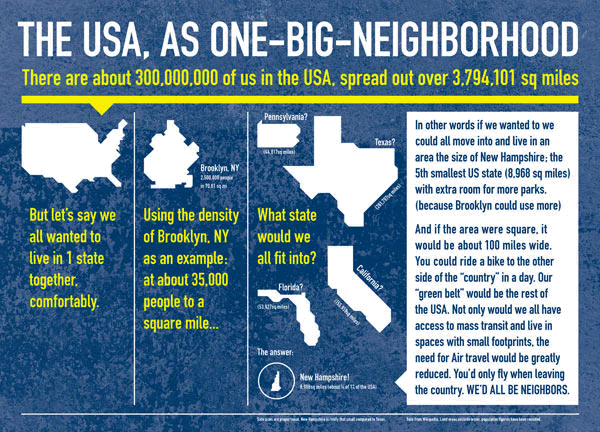
Thanks StangeMaps
I´m in Torres Del Paine park in Chile trekking through incredible terrain. On this night I´m at one of the fancier ´refugios´ in the park, so they even have internet access.
I wanted to quickly check-in with email to make sure that everything´s OK at home and I had to buy 30 minutes of time, so I figured I´d write a quick note.
This park is really amazing. The Refugios are just what they should be (though this one is a little over the top): simple rest stops for the weary hiker. A bed, a beer, a dinner, and a warm atmosphere. We really need more hut-to-hut options in the states.
The scenery has been fantastic. I look forward to downloading my photos onto a computer so that I can check them out on a big screen.
Looking forward to the next few days of trekking and checking out glaciers before heading back to civilization.
Great mention in Wired magazine about Better Place (the company founded by Shai Agasi, that I initially pointed to here) starting a pilot program in Tokyo for their all-electric vehicles.
I really like the concept of removable battery packs – akin to filling up your car with fuel, as you do today – as a way to expedite the move to electric. I also love the idea of electric city cars – perhaps best represented by the Taxi.
I hope that this takes off and I hope we see more of this in the very near future.

Dylan enjoying a morning walk at India Basin in San Francisco

I’ve never been a member of Costco – I’ve lived in smaller apartments since going to college and lived alone for many of those years and have never had the space or need to buy in bulk.
Additionally, I’ve wondered about the cost-effectiveness of buying such mass quantities (at a discount) and then paying for the local storage (in one’s home). In essence, by buying in smaller quantities, I’m passing on the cost of storage back to the retailers.
In addition to the physical space required to store this stuff, there’s also costs for things like extra large or additional fridges/freezers. I found this post from Get Rich Slowly to be pretty interesting in two ways: First, the breakdown of the cost of operating an additional freezer. Granted, I believe his math is a little flawed (it doesn’t take into account differences when the unit is opened more or less during a period of time nor does it look at seasonal temperature differences (though he live in Portland so these are probably less extreme than in other parts of the country). A better test would be to monitor the device over a longer period of time. I was surprised by the overall estimated cost of running the freezer – not that expensive really. (I won’t get into other considerations when buying in bulk, storage, the quality of frozen vs. fresh or the cost implications of a long-term power outage…)
The operating cost is an interesting piece of data. Leading me to the second item I found interesting – the energy measurement device that he has – the Kill-a-watt meter. This is such a great idea. You plug in your electronic devices and the unit measures the electrical draw. I’m really intrigued by this and am considering buying one – I tend to be a little geeky that way.
To me (and it’s not just me, I’ve read plenty of others who are saying the same thing) one of the biggest problems we have today with energy conservation is a lack of measurement tools. Time and again, reading reports of the hybrid electric vehicles you see the authors talking about their energy use. Yes, this is key to a hybrid car – but it’s also an indication of how easy it is to report on that statistic – these cars make it incredibly easy to see what your consumption is.
It would be really interesting to see what would happen if all of our devices were telling us how much energy they were consuming on a daily basis. I for one am OK with energy conservation – I unplug some devices when they’re not in use, but even with my $35 monthly utility bill, I know I could shave off more – I wonder how much.
This video is an excellent presentation about one potential way to get electric cars on the road as a reality in the next few years.
I am amazed by the number of compelling ideas that are covered in this short piece and I HIGHLY recommend it to everyone.
Shai Agassi was a president at SAP but left that post to found his current company, Better Place. I first saw this video through my TED feed on my Boxee unit and I was floored. I’ve since watched it again to show others, and I recently stumbled across this article on Wired about one of the battery stations that he mentions in the presentation.
If the video doesn’t show up, you can also see it here: http://www.ted.com/index.php/talks/shai_agassi_on_electric_cars.html