Technology

27th August
2010
written by Christian
Think different - iMac G3
Image by LuizNonato via Flickr

For years I used to ponder the Apple ad campaign “Think Different.”

The thing about it was, what I would ponder, was their use of grammar.

Apple, through this campaign, was telling the world that users of Macintosh were different from the rest – they were unique thinkers.  This campaign was filled with images of rebels – from Martin Luther King Junior to John Lennon to Albert Einstein.

But the thing was, their use of ‘different’ and not ‘differently.’  By saying “Think different,” Apple was using an adjective, not an adverb.  In other words, they were telling you WHAT to think, not HOW.

Of course I appreciate that “Think Different” sounds better than “Think Differently.”  The latter just doesn’t roll off the tongue quite as satisfyingly.  And I imagine that was the driving force behind the decision.  I have to give Apple credit that they were smart enough to have realized the grammatical implications of their word choice.  And I do believe that they consciously decided to go with their choice because of the strength of the phrase, not the literal translation.

But I also think that Think Different fits better with my view of the company.  I believe that they see it as part of their role to tell their customers what to do & what to think – that they know what’s best for their customers.

As much as I think that Apple makes some of the best computer systems out there, I think they apply too much of a heavy-hand on how their components can be used – and I don’t understand the reasoning.  The reality is, most customers are only comfortable downloading approved applications and most people are not interested in hacking their Apple TVs or installing OSX on different hardware.  To go after this minority of customers is a distraction keeping them from producing even better systems.  But I truly believe they can’t help themselves.  They are too used to telling their customers WHAT to do, and, WHAT to think.

25th May
2010
written by Christian

I came across this article the other day from the New York Times.  In it, the author makes the case that the Open Web is a bit like a city: disorganized, dirty in places, unsafe in others; and that the application-based environments of the iPhone and the iPad is more like a suburban neighborhood with its safe and clean streets.

Something about this really resonated with me.  For the same reason that I live in the city I like the idea of having more open access to my computing experience.  I appreciate the Apple for its focus on design and the experience but, as I’ve written several times in the past, I’m not a fan of their heavy handed control.  In the same way, I like living in the city, where all walks of life are around and every day you can experience something new as opposed to the quiet suburban lifestyle where the experience is more controlled.

While I think the new iPhone (and its operating system) offer some compelling new features, I’m looking forward to this summer when I’ll be able to ditch my AT&T contract without penalty and switch to a more open platform like Google’s Android system.  Don’t get me wrong – I’m also not a fan of allowing Google to have access to having so much of my information but for the time being their system is more compelling to me than Apple.

8th March
2010
written by Christian

Something occurred to me today in that odd way that ideas just all of a sudden appear in one’s brain.  It’s one of those weird thoughts that often times I just dismiss, ignore, or sometimes play out, only to realize later that it’s just a bunch of crap.

There’s all this reporting lately of the demise of big media – that the internet is killing establishments like The New York Times or NBC.  More specifically, that giving away their content for free on the internet was a bad business move and is destroyed their underlying business.

I’m not a fan of that perspective – I feel like a lot of content has already been ‘free’ – over-the-air TV and Radio, and even the nominal fee for a daily newspaper hardly covers the production costs.  They’ve been supported by advertising and my feeling is that they’ve got to figure out a way to make advertising work online.

So the idea today starts with this: It’s the low-cost barrier that the internet has enabled that is destroying old media – YouTube vs. NBC; blogs vs. New York Times.  This idea isn’t new and I believe it’s accurate.  People are more interested in the varying content online, and specifically they’re able to match content to their particular world-view better than they could with any of the large nation-wide media companies.

But here’s what hit me today: Advertisers are in the same boat as the old media companies.  Coca-cola is trying to reach a national audience (world-wide audience actually) and it’s going to get tougher and tougher to cater their message to the more and more niche markets represented by online media.  This represents an opportunity for local products to compete with their national/global competitors in the same way that local media now has the opportunity to compete with their national competitors.

Could we see the return of regional products like soda and beer? Restaurants & clothiers?  That prospect interests me – as one who likes to travel one of the aspects I enjoy is how different the world can be the further one gets from home – could it be that traveling to the next state over could be as it once was?  Will we see the products and services breaking into smaller regional offerings?

4th March
2010
written by Christian

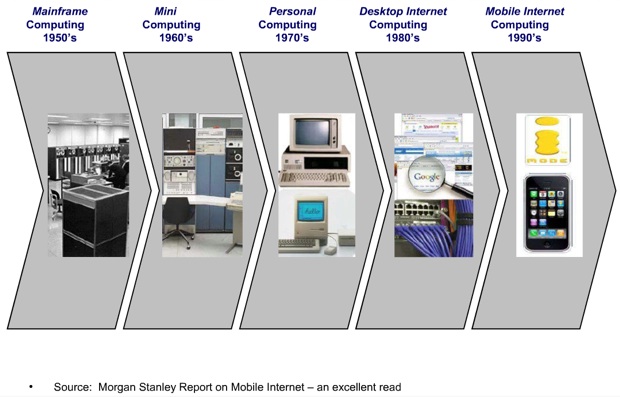
I stumbled upon this image today during my morning browsing and I couldn’t help but to laugh.

At first it was the idea that the 90s was the decade of the mobile internet.  Um… really?  I can pretty much remember browsing the internet on my first Sony/Sprint phone.  After about 10 minutes (and who knows how many dollars) I think I had rendered some bad mobile site’s input field to search for movie times or something.  The search results would have taken another half hour I’m sure.

My first reaction was that they had leapfrogged a decade – one could argue that the 00s was the decade of the mobile internet (but I would really push that to the 10s).

But then I saw the 80s.

Really?  Internet computing in the 80s?  I barely had my Compuserve account in the 80s (like, ’89) let alone — a Google screen shot?!  I’m not sure I’d associate a company founded in 1998 with the decade of Pac Man and the Apple II.

Makes one question Morgan Stanley’s credibility.  Though I guess you don’t need this image to tell you that banks don’t always get it right.

28th January
2010
written by Christian
Apple Inc.
Image via Wikipedia

I have long admired Apple‘s ability to produce high-quality products, from their early Apple II ad Mac products through the iPod and iMacs of today.  But I have often held off purchasing Apple’s products because of their maniacal control that they place over their systems.  I was disappointed (but not surprised) that yesterday’s iPad announcement continues their insistence that the iPad will continue to be a closed ecosystem allowing only approved App store applications.

The iPhone is a wonderful device but really I should be able to install software of my choosing, just like on a computer.  I have the same gripe with the AppleTV.  I absolutely loved Boxee on the Apple TV, as I’ve written about in the past but I eventually had to give up on it because of the constant upgrade wars with Apple.  Now, if I want to watch the State of the Union address (or many other shows), I have to watch on the computer and not the TV because Apple has said so.

Were I to do it over again today, I’d buy a Mac mini and attach that to the TV, instead of an Apple TV.  That way I’d have the ability to install and run whatever application I want – Boxee, a web browser, etc.,

And were I to do it over again today, I’d buy a Google phone.  I’m aware of the shortcomings of the current Google application offering but that will only improve as more people adopt that device (or, more accurately, device platform).

And so, what will I do today?  Will I buy an iPad?  (Beside the fact that I’m not really in the market and won’t be buying one in the near future..)  Certainly the device is compelling.  I really think Apple has hit the nail on the head.  It really is a great device for most casual computer users.  Cruise the web, watch a video, look at some photos, check the weather, etc.,  It really is made for the couch (or the train/airplane).  But I won’t be able to install Boxee.  I won’t be able to run flash.  I won’t be able to install Firefox.  I won’t be able to decide whether the power-burden of background apps is acceptable or not.  These might not be deal-breakers for the iPad device – but if this signals the future of computing platforms – closed ecosystems where you have to fully buy in to one company’s environment – one where you have little control over how it works – I’m concerned.

26th August
2009
written by Christian

Great mention in Wired magazine about Better Place (the company founded by Shai Agasi, that I initially pointed to here) starting a pilot program in Tokyo for their all-electric vehicles.

I really like the concept of removable battery packs – akin to filling up your car with fuel, as you do today – as a way to expedite the move to electric.  I also love the idea of electric city cars – perhaps best represented by the Taxi.

I hope that this takes off and I hope we see more of this in the very near future.

Previous
Next
  • You are currently browsing the archives for the Technology category.